Two custom dice can carry the same artwork, the same numbers, and the same size, and still feel like entirely different objects in the hand. The reason is material. What a die is made of governs its weight, the sharpness of its edges, how much fine detail the mold can hold, how it survives a fall onto a hard floor, and a good part of what it costs to produce. Before locking a color or a logo, it pays to understand what each material does well and where it gives something up. This is a look at the main options a custom order will put in front of you.
Acrylic and resin are both plastic, and they are not the same
The two materials that cover most custom dice are acrylic and resin, and buyers often treat them as interchangeable when they are not. Acrylic is a thermoplastic that is molded and sets as it cools, which lends itself to bright, saturated colors and clean, simple shapes produced consistently at scale. Its limitation is detail: because the material is comparatively soft, molds cannot hold very fine features, so acrylic dice tend toward bold designs with slightly softer edges, and painted numbers can wear away over time if the dice are handled hard.
Resin works by a different mechanism. It is cast from two components that harden through a chemical reaction, and that process allows far more intricate molds, including sharp edges and embossed or debossed detail that acrylic cannot reproduce. Resin is also harder and more scratch-resistant, and its transparency lets makers suspend glitter, metal foils, mica, or other inclusions inside the die. The trade-off is cost and consistency: resin dice are almost always more expensive because the process is slower and more hands-on, and small batch variation is part of their character rather than a defect. For a large promotional run in a couple of solid colors, acrylic is usually the sensible choice; for a premium, detailed, or collectible piece, resin earns its price.
Metal is weight you can feel
Metal dice, usually cast from a zinc alloy and then plated, occupy the opposite end of the spectrum from plastic. The defining property is heft. A material’s density tells the story cleanly: acrylic and resin sit right around 1.2 grams per cubic centimeter, glass and gemstone roughly double that, and solid zinc alloy lands near 6.6, which works out to a same-size metal die weighing on the order of five to six times its plastic equivalent. The chart below lays those densities side by side, and the gap is the whole reason metal dice have their reputation.
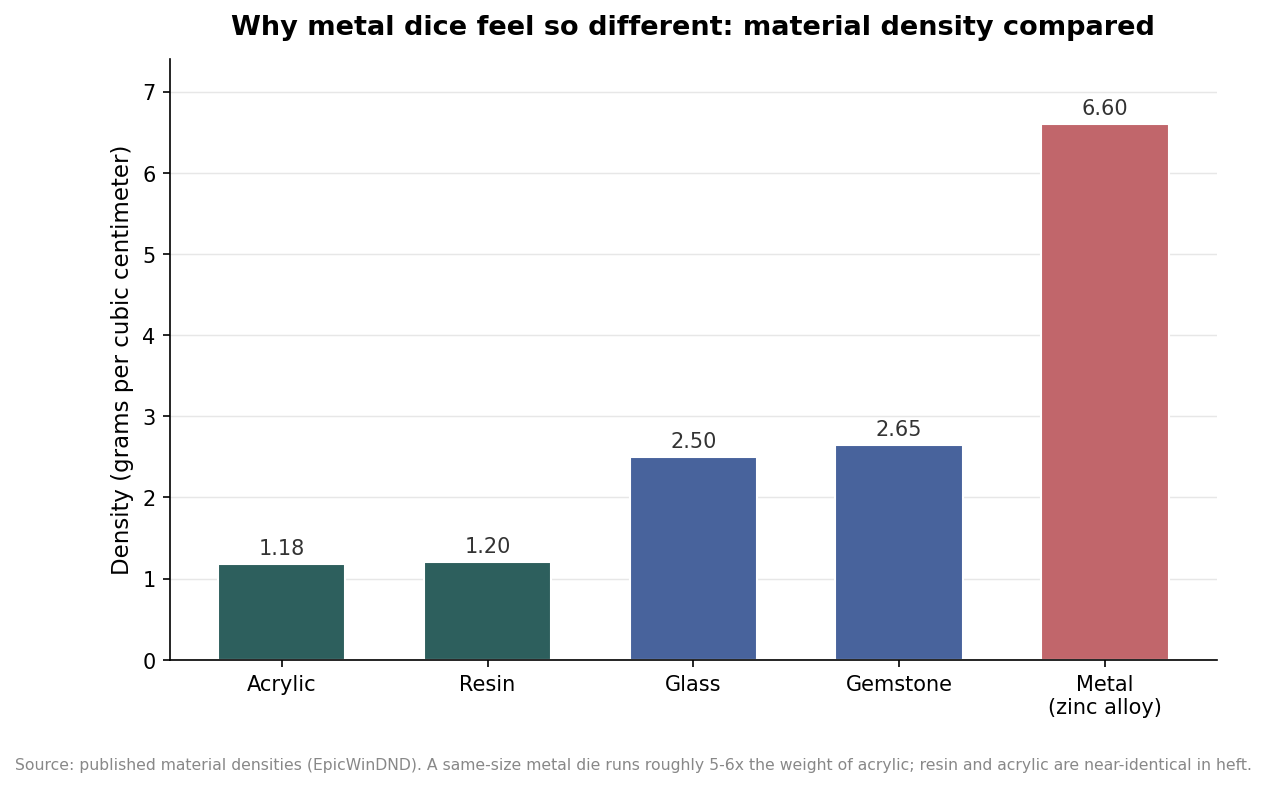
That weight changes behavior on the table. Metal dice settle quickly with little bounce and land with a solid thud rather than a clatter, which many players prize and which also makes them feel substantial as a gift or a keepsake. Durability is excellent; the main cosmetic change over years of use is that the plating slowly wears and a patina develops. The costs are real, though: metal dice are heavier to ship, more expensive to produce, and hard enough that a dropped set can chip a table or a glass surface, so they are typically rolled in a tray. For a custom order meant to impress, metal delivers; for volume giveaways where postage matters, its weight is a line item.
Stone, glass, and wood fill the specialty tier
Beyond the plastics and metal sit a set of specialty materials chosen more for character than for practicality. Gemstone dice are cut and polished from natural stone, giving each one a unique grain and a medium-heavy feel at roughly 2.2 times the weight of acrylic, but stone is brittle and can crack if dropped on a hard floor, and the premium pricing reflects the labor of cutting. Glass offers a clear, bell-like sound and a medium weight but is similarly brittle. Wood is light, warm, and quiet on the table, with a soft thump rather than a clack, though it can warp with exposure to moisture and holds less fine detail than resin. None of these is the right pick for a rugged, high-volume run, but each makes sense when the material itself is meant to be part of the appeal.
Size changes everything about the feel
Material is only half the equation; size interacts with it strongly. The industry standard for a six-sided die is 16 millimeters, and it is the size with the widest selection of colors, finishes, and designs, which makes it the safe default for most custom work. Smaller 12-millimeter dice are favored when players roll many at once, as in mass-battle miniatures games, while 10-millimeter and 5-millimeter dice serve compact sets and specialty uses. Going the other way, 19 millimeters matches casino gaming dimensions and reads well from across a table, and jumbo sizes of 25 millimeters and up move into display and novelty territory. The chart below shows the common sizes on one scale.
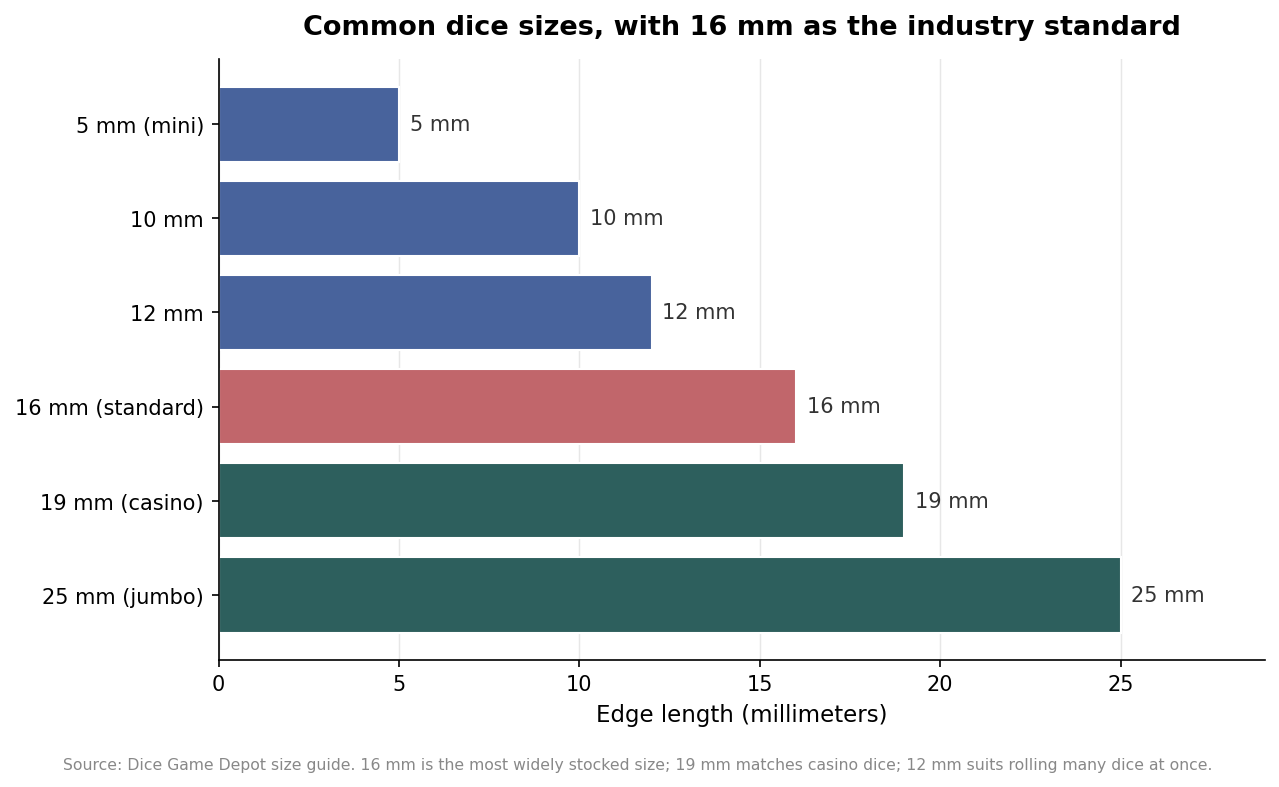
The reason size deserves attention on a metal or stone order in particular is that weight scales with volume, not with edge length. Doubling the edge of a die multiplies its volume, and therefore its weight, by roughly eight. A 19-millimeter metal die is not a little heavier than a 16-millimeter one; it is dramatically heavier. That compounding is why honest sellers quote weight as a range tied to a specific size rather than a single number, and why picking size and material together, rather than in sequence, avoids surprises.
Matching the material to the job
The right material follows from how the dice will be used. A large branded run in a few solid colors points to acrylic for its low cost and consistent output. A detailed, transparent, or inclusion-filled design points to resin, accepting a higher price and some batch variation. A premium gift or a set meant to feel serious points to metal, with its shipping weight and tray-friendly hardness factored in. Stone, glass, and wood are for when the material is the message. Set the size in the same breath, defaulting to 16 millimeters unless the game or the display calls for something else, and remember that on the heavier materials a step up in size is a large step up in weight and cost. Chosen this way, the finished dice feel in the hand exactly the way the design promised on the screen.