A custom die is a small object with a surprising number of decisions packed into it. Get the size wrong and a promotional die is unreadable across a trade-show table; get the edges wrong and a set meant for a casino feel rolls like a toy. When you order in bulk, those choices multiply across thousands of units, so it pays to specify them deliberately rather than accept a factory default. This is a working walkthrough of the specs that actually change the product, in the order you should decide them.
Start with size, because size sets everything else
Dice are measured by the edge length of the cube, and a handful of sizes cover almost every use. The industry benchmark is 16 millimeters, the size of a classic board-game or tabletop die, comfortable to pick up and read. Casinos and party games favor 19 millimeters, big enough to read across a table and to carry sharp, precise edges. Compact 12 millimeter dice are built for rolling many at once, the norm in miniature war games, while 5 millimeter micro dice serve as score or status markers. At the other end, jumbo dice of 30 millimeters and up are display and novelty pieces rather than playing dice.
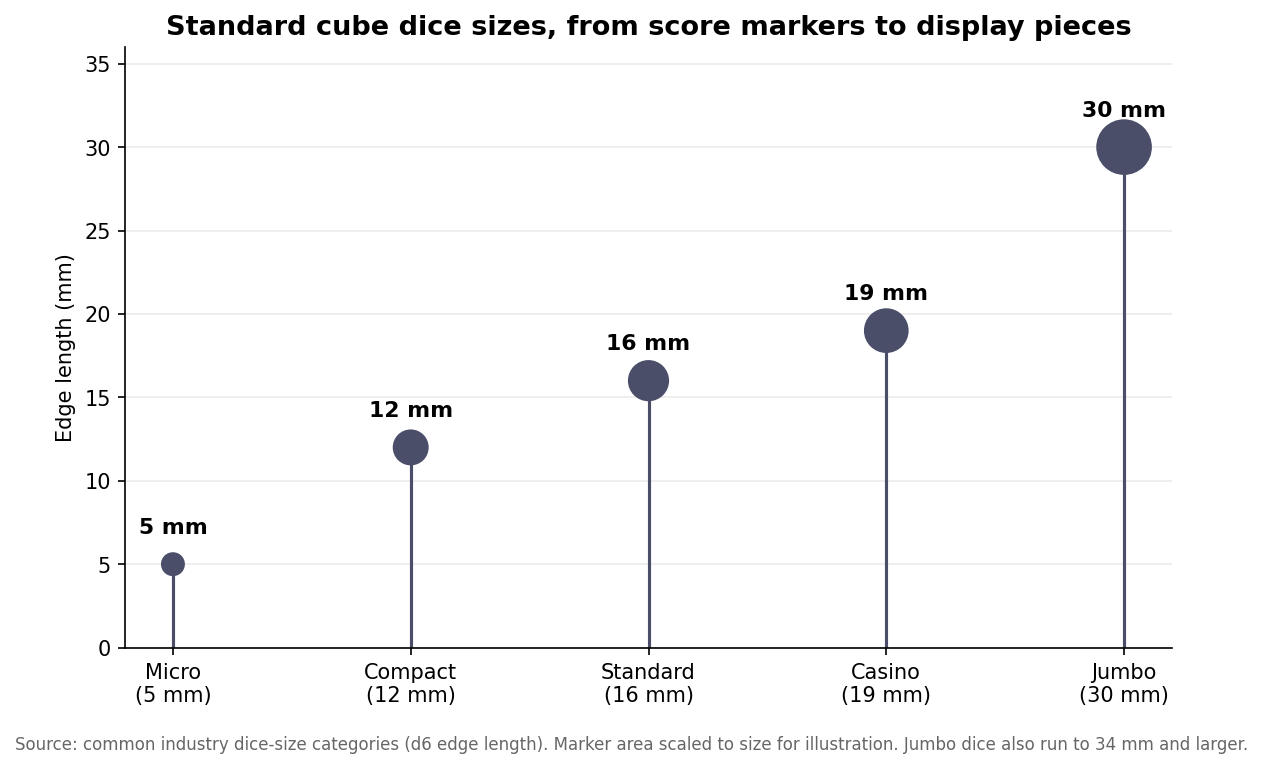
Size drives everything downstream. It sets how much room you have for artwork on each face, how legible small pips or numerals will be, and how heavy and expensive the finished die is in bulk. Decide it first and every later choice gets easier.
Edges: rounded for play, sharp for precision
The corners and edges of a die are a real specification, not a cosmetic afterthought. Mass-market molded dice have gently rounded edges and corners, which makes them tumble freely and forgiving to handle, the right call for board games and giveaways. Precision or casino-style dice use sharp, near-square razor edges, which look crisp and are associated with fair, controlled rolls, but they are less comfortable in the hand and show wear faster. If your dice are for play and promotion, rounded is almost always right; reserve sharp edges for products where a precise, high-end feel is the point.
How the faces are decorated
There are three common ways to put numbers or a logo on a die, and they land at different price and durability points. Engraving, or debossing, cuts the pip or numeral into the face; left unpainted it is subtle and extremely durable because there is no ink to wear off. Engraved-and-painted fills that recess with color, the familiar look of white pips on a colored die, giving contrast that still resists rubbing because the paint sits below the surface. Printed or UV-printed faces lay artwork flat on top of the die, which allows full-color logos and fine detail but sits more exposed to handling wear. For a die that will be rolled thousands of times, recessed and filled decoration outlasts surface printing; for a short-run showpiece with a detailed logo, printing opens up options engraving cannot match.
Quantities and how dice are packed
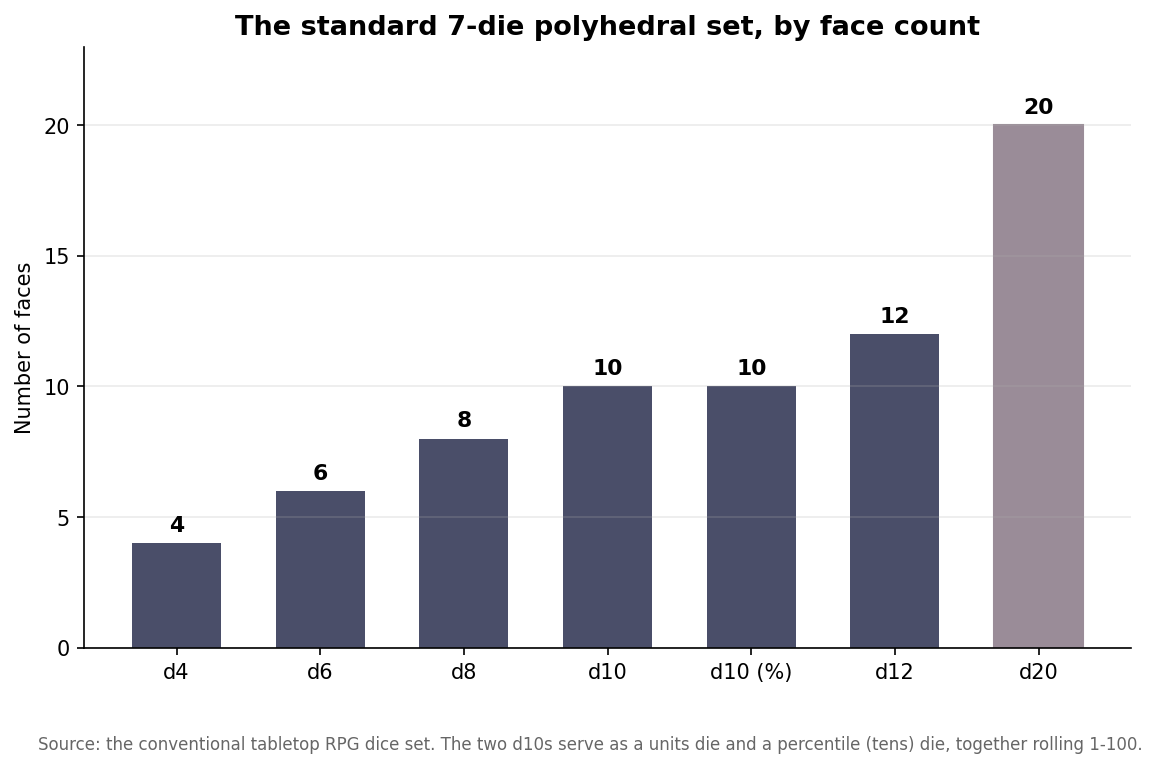
How your dice are grouped is part of the order, not an afterthought at the warehouse. Classic six-sided dice ship as singles, as pairs for backgammon and craps, as sets of five for poker dice and Yahtzee-style games, and as bulk blocks for game publishers. Tabletop role-playing uses the standard seven-die polyhedral set, which spans four, six, eight, ten, twelve, and twenty faces, with two ten-sided dice that together roll one to a hundred.
Per-unit pricing depends heavily on the die size, the decoration method, and whether you want custom colors, so treat any price as indicative until it is on a written quote. At Get Custom Dice the minimum order is 12 dice per design; as a rule, custom colors and multi-step decoration raise the per-die price, while a single-color engrave on a standard size keeps it lower. Decide your pack configuration early, because a set of seven mixed shapes is a very different manufacturing job than a bulk run of one cube.
Color and contrast that survive a table and a photo
Color is where custom dice either read instantly or turn to mush, and it works on two layers: the body of the die and the fill in the numbers. A high-contrast pairing, light pips on a dark body or the reverse, stays legible across a table and in a product photo; a tonal pairing like grey on charcoal looks elegant in the hand but disappears at a distance and photographs poorly for a listing. Translucent and swirled bodies add visual interest but can fight legibility, because a numeral has to compete with the pattern behind it, so they reward a bolder, higher-contrast fill. If the die carries a brand color, decide whether that color belongs on the body, in the pip fill, or both, and check it at the actual finished size rather than on a zoomed-in screen where everything looks readable. A face that reads cleanly at 16 millimeters is a different design than one that only works blown up.
Putting a spec sheet together
Bring five things to a quote and you will get an accurate one back. State the size in millimeters, the edge style as rounded or sharp, the material, the decoration method, and the pack configuration with the total quantity. Add your color, whether that is a body color, a pip or ink color, or both, and note any artwork that has to reproduce cleanly at the chosen size. With those settled, the rest of the conversation is about lead time and tooling rather than guesswork, and the dice that arrive match the ones you pictured. Specify loosely and you inherit the factory’s defaults; specify tightly and the small object does exactly what you need it to.