Buy a bag of six-sided dice for a board game and the decision is easy. Order a custom set for a role-playing product, a teaching tool, or a branded gift, and suddenly there are seven differently shaped objects to account for, each with its own geometry, its own probabilities, and its own reason for existing. Understanding what each die in a polyhedral set actually is, and why the shapes were chosen, makes it far easier to specify the right set and to explain it to whoever receives it. This is the plain-language version of that geometry.
What a standard polyhedral set contains
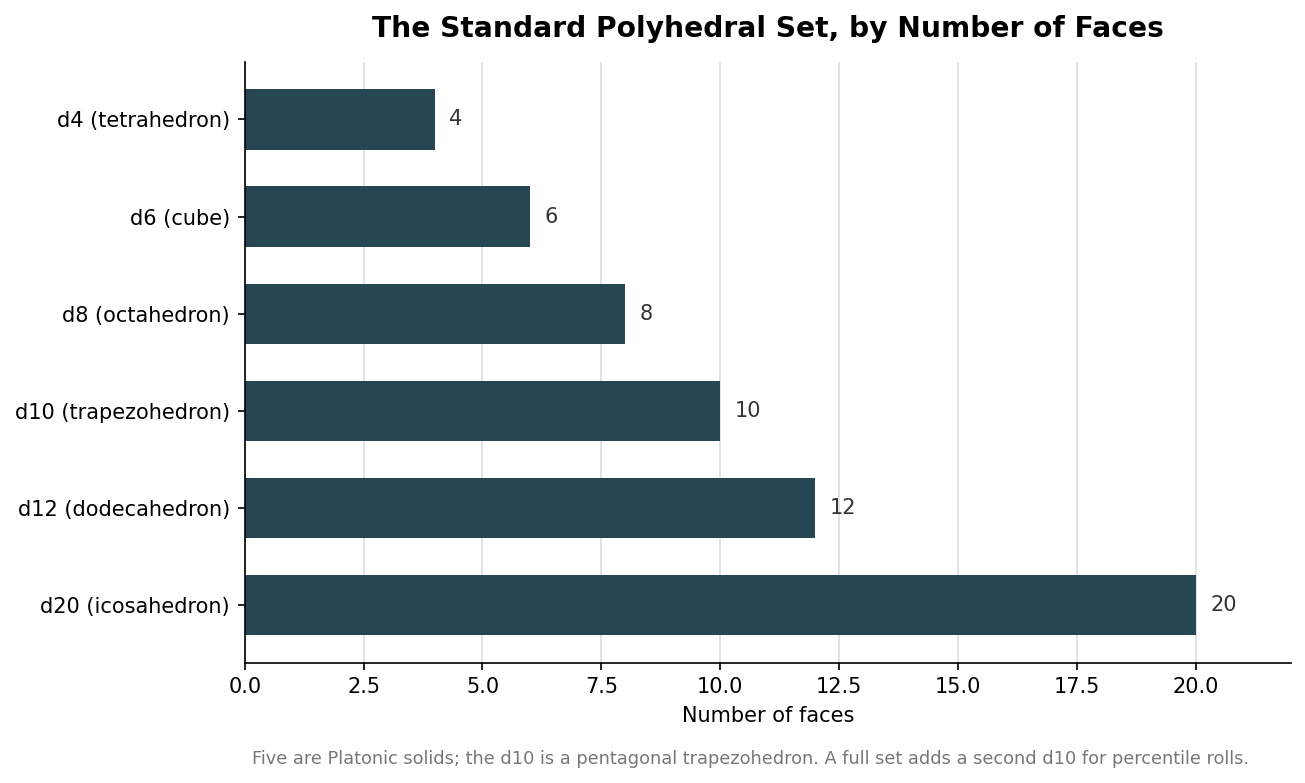
The familiar seven-die set is d4, d6, d8, d10, d12, and d20, plus a second d10 for percentiles. The number after the d is simply the number of faces, so a d20 has twenty numbered faces and a d4 has four. The chart below lines them up by face count, which is the single most important spec because it defines the range of numbers the die can produce. A d6 gives you one through six; a d20 gives you one through twenty. When someone specifies a custom set, they are almost always talking about these seven pieces, and the extra d10 is what makes rolling a number from one to one hundred possible.
Why these particular shapes
Five of the shapes are the Platonic solids, and that is not a coincidence. A Platonic solid is a shape whose faces are all identical regular polygons meeting in the same way at every corner, and there are exactly five of them: the tetrahedron with four faces, the cube with six, the octahedron with eight, the dodecahedron with twelve, and the icosahedron with twenty. That perfect symmetry is precisely what a fair die needs, because if every face is identical then no face is favored. This is why the d4, d6, d8, d12, and d20 look the way they do rather than being arbitrary lumps with numbers on them.
The d10 is the exception worth knowing. There is no Platonic solid with ten faces, so the ten-sided die is built as a pentagonal trapezohedron, a shape made of ten kite-shaped faces. It is still designed to be fair because its faces are identical to one another, but it is a different family of geometry from the other five. Mention this when a customer asks why their d10 has that distinctive elongated, diamond-faceted look while the rest of the set is made of tidy triangles and pentagons. It is also why the two d10s in a full set can be numbered differently, one running zero through nine and the other in tens from zero to ninety, so that rolled together they read as a single number from one to one hundred.
What the probabilities actually are
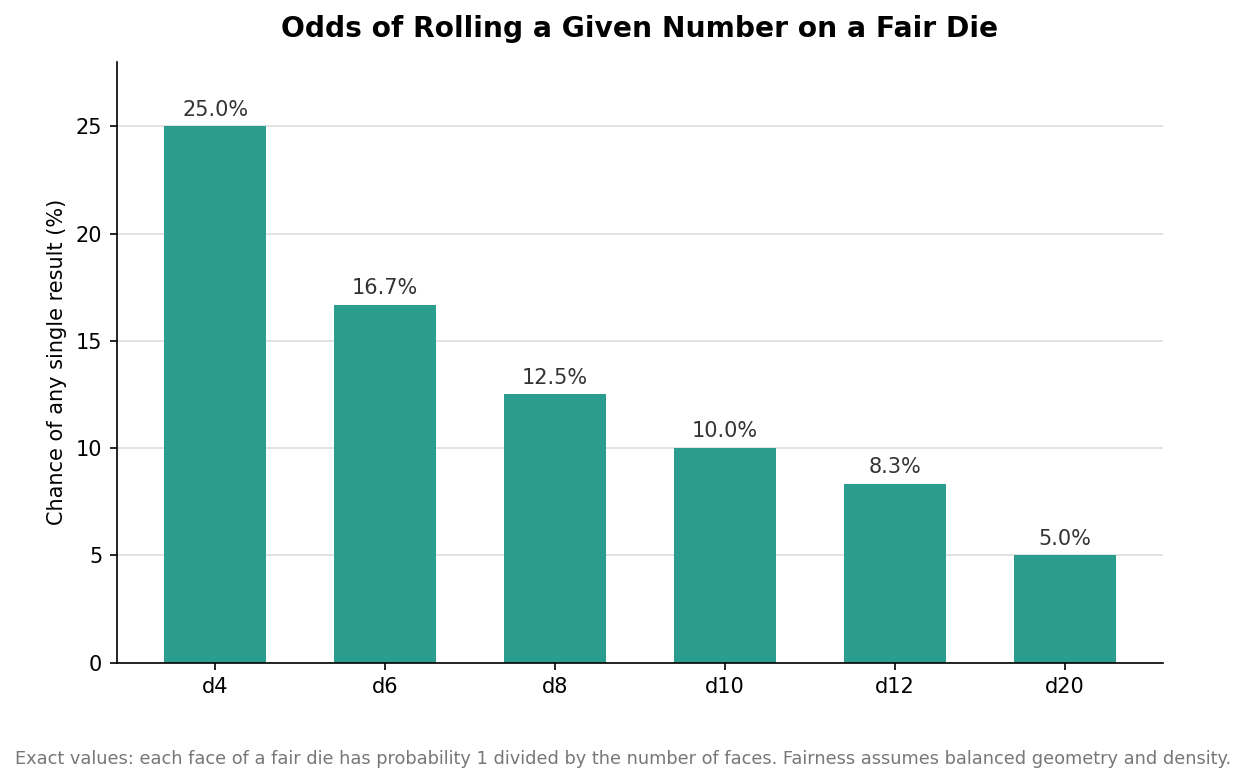
On a fair die, every face is equally likely, and the odds are exactly one divided by the number of faces. That makes a single result on a d4 a one-in-four event, or twenty-five percent, while a specific number on a d20 comes up only five percent of the time. The second chart shows these exact values across the set. They matter for design as much as for play: a game that leans on the d20 is built around rarer, higher-variance outcomes, while one that uses the d6 produces flatter, more predictable results. If you are commissioning dice for a specific game or classroom exercise, choosing the die is really choosing the probability curve you want.
One caveat belongs with that math. The clean percentages assume a genuinely fair die, which depends on balanced geometry and uniform density. A die with an off-center bubble in the resin, uneven paint fill weighting one face, or rounded-inconsistent edges will drift from these ideals, which is why manufacturing quality is not separate from fairness but part of it.
Matching the set to the job
Not every project needs all seven shapes. A tabletop role-playing product typically wants the full set because the rules call on different dice for different actions, with the d20 doing the heavy lifting for checks. A board game or a promotional giveaway is often better served by custom d6s alone, which are cheaper per unit, stack and pack easily, and carry a logo or custom pips cleanly on their flat faces. An educational set might emphasize the d6 and d10 for teaching probability and place value, where the whole point is that students can see and feel why a ten-sided die produces flatter odds than a four-sided one. A marketing or event set often does best with a single distinctive die that carries the brand well and survives being handled and pocketed. And a precision or casino-style application is a different world again, built around larger, sharp-edged, tightly toleranced cubes, commonly around three-quarters of an inch, rather than the roughly sixteen-millimeter dice that fill a standard polyhedral set. Decide what the dice are for, and the shapes, sizes, and quantities follow from there rather than the other way around.
Once the geometry is clear, the rest of a custom order, material, edge style, decoration, size, and packaging, sits on top of a solid foundation. Knowing that the numbers you can roll come straight from the number of faces, that symmetry is what keeps a die honest, and that the d10 is the odd one out, is enough to specify a set with confidence and to explain every piece of it to the person who ends up rolling it.