Most buyers choose a die’s material and size, approve the artwork, and never ask the one question that decides how the finished dice will look and hold up: how does the number actually get onto the face? A pip or numeral can be formed in the mold, carved into the surface, or printed on top of it, and those three routes behave very differently in a shared dice bag over a few years. This is a comparison of the four common marking methods, what each does well, and how to match one to the job.
The four ways a face gets made
Molded or embedded marks are formed as part of the die itself, either as recessed pips or as a second color of material set into the face during production. Because the mark is integral to the body rather than added afterward, it is the most durable option and the one behind casino-grade precision dice. The trade-off is that it requires a custom mold, which raises both setup cost and the minimum order.
Laser engraving removes material to carve the numeral or pip into the surface, leaving a permanent recessed geometry that cannot peel or rub off. On its own the result is monochrome, its shade set by the substrate, but the recess is usually filled with ink or enamel to add contrast and color. Crucially, that fill sits down inside a protected channel rather than on the exposed surface.
UV or digital printing lays cured ink directly on the face and is the only method that delivers full color, gradients, and photographic detail. General decoration data for hard goods puts the life of cured UV ink at roughly five to ten years or more with reasonable care, but because the layer sits on top of the material, heavy abrasion can wear it over time. It is the right call when the look of the die matters more than surviving a decade of rattling around.
Pad printing transfers a spot color of ink to the surface and is the economical route for a simple logo, single custom face, or promotional mark at volume. Like UV, the mark rides on the surface, so it favors items that will not see constant hard contact.
Durability: what survives a dice bag
The single biggest differentiator is whether the mark is in the material or on it. Recessed and molded marks win on abrasion because the working surface of the die wears against the flat faces, not down inside the engraved channels where the ink lives. Surface prints, however vivid, are the first thing to show wear when dice tumble against each other, table edges, and the inside of a pouch. If the dice are destined for a communal game bag or years of daily play, that distinction usually outranks every other consideration.
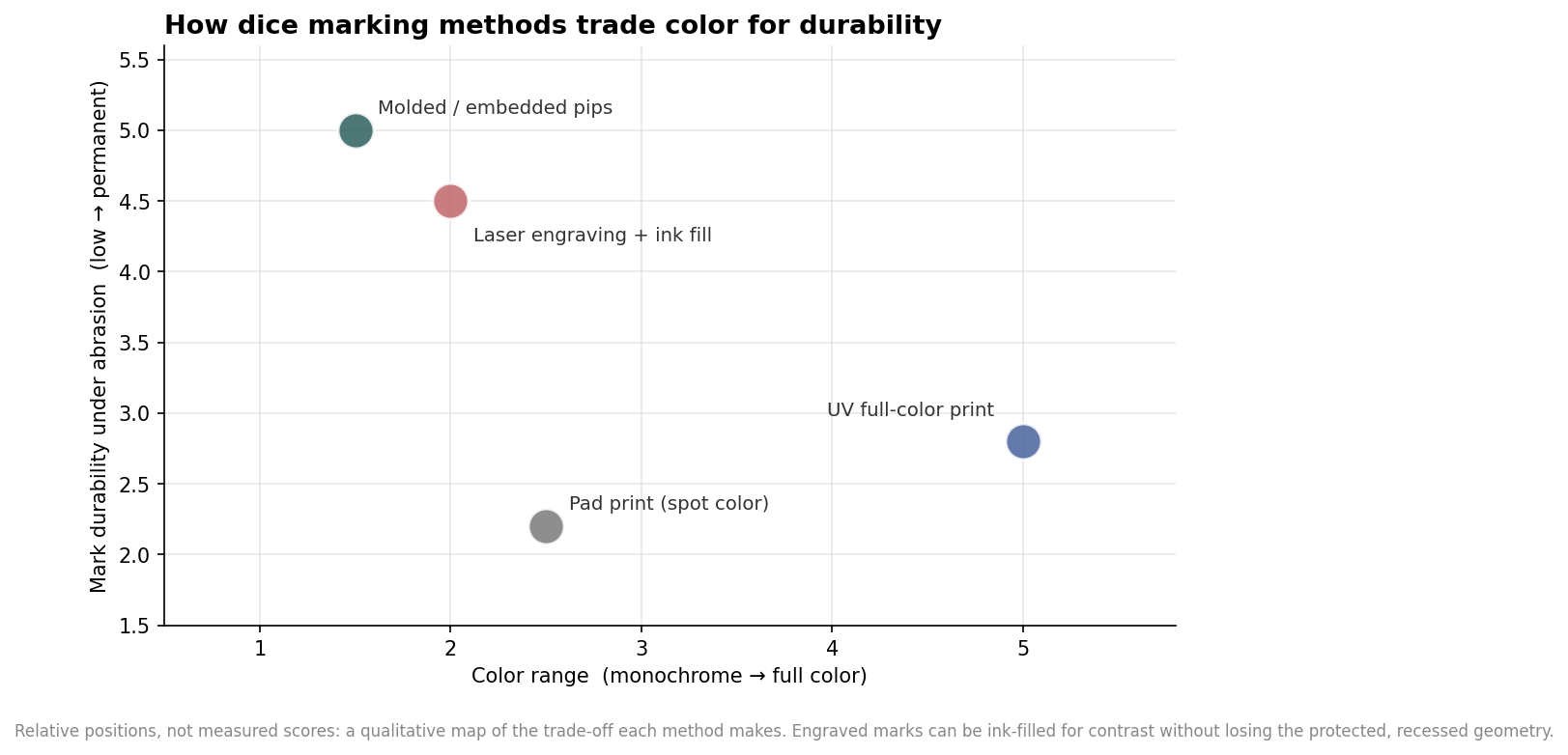
None of this makes printing a poor choice; it makes it a specific choice. A full-color collectible that lives in a display case faces almost none of the abrasion that punishes a well-used gaming set, so the method that looks best there is not the method that lasts longest in a pocket.
Color and legibility
Legibility is a function of contrast, and each method reaches contrast differently. Engraving alone relies on the shadow of the recess, which reads cleanly on light materials but can disappear on dark ones unless the channel is ink-filled. Ink or enamel fill solves that by dropping a contrasting color into the engraved geometry, which is why filled engraving is the workhorse for readable numerals. UV printing offers the widest color range and the sharpest small detail, making it the choice when a face carries a multicolor logo or intricate iconography. Whatever the method, the faces still have to read at a glance during play, so high contrast between mark and body matters more than the number of colors you can technically reproduce.
Cost, minimums, and lead time
Fully custom molded dice carry tooling costs and the longest schedules, because a scratch-built mold has to be made and approved before production starts. Engraving and printing applied to blank stock dice skip the tooling step, which lowers both the minimum order and the wait, at the cost of some design freedom. Per-die pricing depends on the material, size, decoration method and quantity, and like any manufactured product the number falls as quantity rises. For a figure on your specific design, send your artwork through the Get Custom Dice quote form for a free mockup and quote within one business day.
One practical note on minimums: at Get Custom Dice the minimum order is 12 dice per design, and standard production ships in about 2 weeks after mockup approval (faster turnaround is available with express shipping).
How to choose
Work from the die’s future life rather than from the artwork. If it will live in a shared bag and needs to survive years of play, choose molded marks or engraving with an ink fill so the geometry is protected. If it is a full-color collectible or a promotional piece where appearance carries the value and abrasion is minimal, UV printing earns its place. If you only need a simple logo on a giveaway at volume, pad printing is the efficient answer. Then, before committing to the full run, get a physical sample in the exact material and decoration you have specified and put it through a few days of ordinary handling. The face is where a custom die succeeds or fails, and it is the cheapest thing to verify before you scale.