Category: Uncategorized

  • How Custom Dice Are Marked: Engraving, Ink Fill, Molding, and Printing Compared

    How Custom Dice Are Marked: Engraving, Ink Fill, Molding, and Printing Compared

    Most buyers choose a die’s material and size, approve the artwork, and never ask the one question that decides how the finished dice will look and hold up: how does the number actually get onto the face? A pip or numeral can be formed in the mold, carved into the surface, or printed on top of it, and those three routes behave very differently in a shared dice bag over a few years. This is a comparison of the four common marking methods, what each does well, and how to match one to the job.

    The four ways a face gets made

    Molded or embedded marks are formed as part of the die itself, either as recessed pips or as a second color of material set into the face during production. Because the mark is integral to the body rather than added afterward, it is the most durable option and the one behind casino-grade precision dice. The trade-off is that it requires a custom mold, which raises both setup cost and the minimum order.

    Laser engraving removes material to carve the numeral or pip into the surface, leaving a permanent recessed geometry that cannot peel or rub off. On its own the result is monochrome, its shade set by the substrate, but the recess is usually filled with ink or enamel to add contrast and color. Crucially, that fill sits down inside a protected channel rather than on the exposed surface.

    UV or digital printing lays cured ink directly on the face and is the only method that delivers full color, gradients, and photographic detail. General decoration data for hard goods puts the life of cured UV ink at roughly five to ten years or more with reasonable care, but because the layer sits on top of the material, heavy abrasion can wear it over time. It is the right call when the look of the die matters more than surviving a decade of rattling around.

    Pad printing transfers a spot color of ink to the surface and is the economical route for a simple logo, single custom face, or promotional mark at volume. Like UV, the mark rides on the surface, so it favors items that will not see constant hard contact.

    Durability: what survives a dice bag

    The single biggest differentiator is whether the mark is in the material or on it. Recessed and molded marks win on abrasion because the working surface of the die wears against the flat faces, not down inside the engraved channels where the ink lives. Surface prints, however vivid, are the first thing to show wear when dice tumble against each other, table edges, and the inside of a pouch. If the dice are destined for a communal game bag or years of daily play, that distinction usually outranks every other consideration.
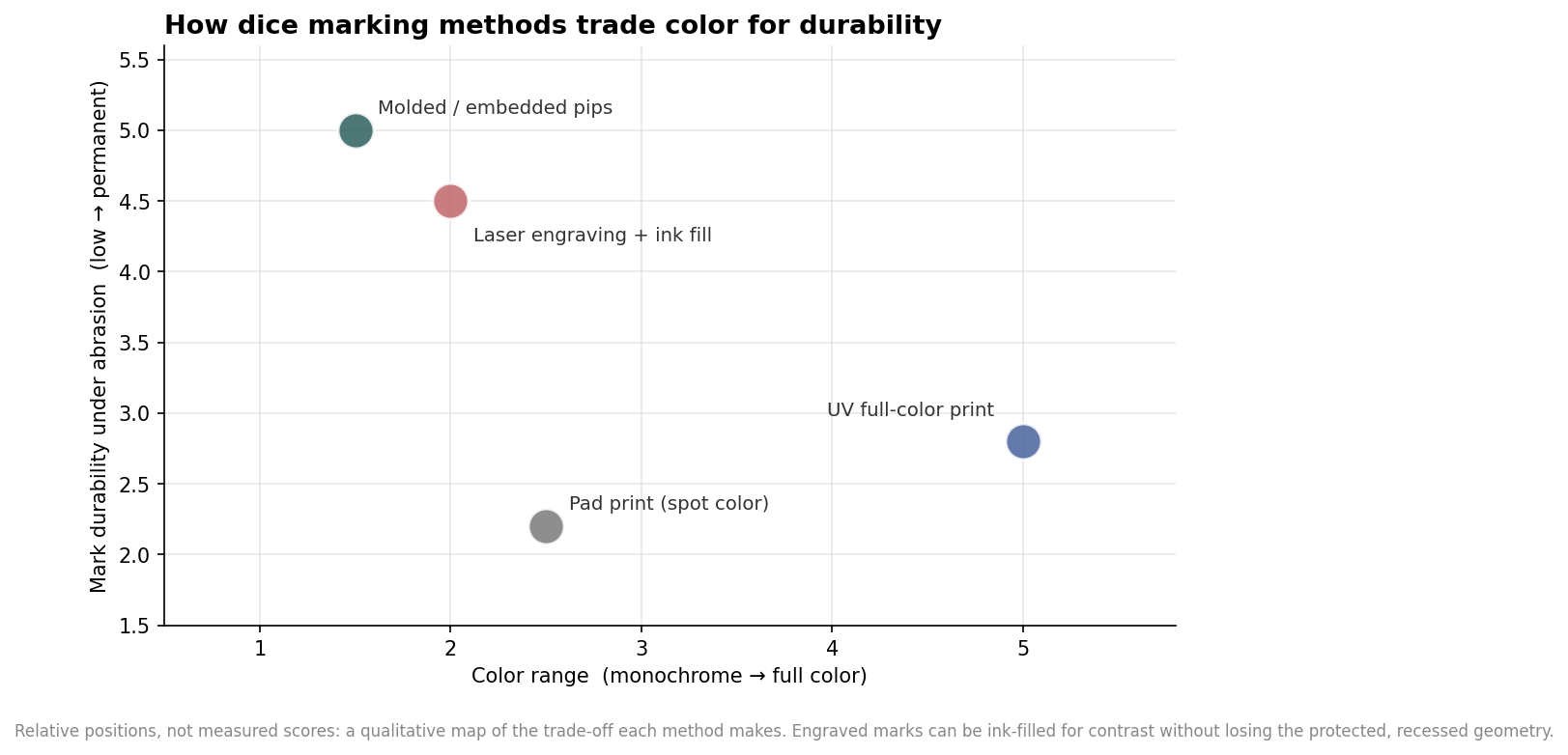
    Scatter chart mapping dice marking methods by color range versus abrasion durability: molded and engraved are durable, UV printing is full color but less abrasion resistant
    A relative map of the trade-off: molded and ink-filled engraving last longest, UV printing offers the widest color.

    None of this makes printing a poor choice; it makes it a specific choice. A full-color collectible that lives in a display case faces almost none of the abrasion that punishes a well-used gaming set, so the method that looks best there is not the method that lasts longest in a pocket.

    Color and legibility

    Legibility is a function of contrast, and each method reaches contrast differently. Engraving alone relies on the shadow of the recess, which reads cleanly on light materials but can disappear on dark ones unless the channel is ink-filled. Ink or enamel fill solves that by dropping a contrasting color into the engraved geometry, which is why filled engraving is the workhorse for readable numerals. UV printing offers the widest color range and the sharpest small detail, making it the choice when a face carries a multicolor logo or intricate iconography. Whatever the method, the faces still have to read at a glance during play, so high contrast between mark and body matters more than the number of colors you can technically reproduce.

    Cost, minimums, and lead time

    Fully custom molded dice carry tooling costs and the longest schedules, because a scratch-built mold has to be made and approved before production starts. Engraving and printing applied to blank stock dice skip the tooling step, which lowers both the minimum order and the wait, at the cost of some design freedom. Per-die pricing depends on the material, size, decoration method and quantity, and like any manufactured product the number falls as quantity rises. For a figure on your specific design, send your artwork through the Get Custom Dice quote form for a free mockup and quote within one business day.

    One practical note on minimums: at Get Custom Dice the minimum order is 12 dice per design, and standard production ships in about 2 weeks after mockup approval (faster turnaround is available with express shipping).

    How to choose

    Work from the die’s future life rather than from the artwork. If it will live in a shared bag and needs to survive years of play, choose molded marks or engraving with an ink fill so the geometry is protected. If it is a full-color collectible or a promotional piece where appearance carries the value and abrasion is minimal, UV printing earns its place. If you only need a simple logo on a giveaway at volume, pad printing is the efficient answer. Then, before committing to the full run, get a physical sample in the exact material and decoration you have specified and put it through a few days of ordinary handling. The face is where a custom die succeeds or fails, and it is the cheapest thing to verify before you scale.
  • The Polyhedral Dice Set Explained: What Each Die Is and Why the Shapes Matter

    The Polyhedral Dice Set Explained: What Each Die Is and Why the Shapes Matter

    Buy a bag of six-sided dice for a board game and the decision is easy. Order a custom set for a role-playing product, a teaching tool, or a branded gift, and suddenly there are seven differently shaped objects to account for, each with its own geometry, its own probabilities, and its own reason for existing. Understanding what each die in a polyhedral set actually is, and why the shapes were chosen, makes it far easier to specify the right set and to explain it to whoever receives it. This is the plain-language version of that geometry.

    What a standard polyhedral set contains

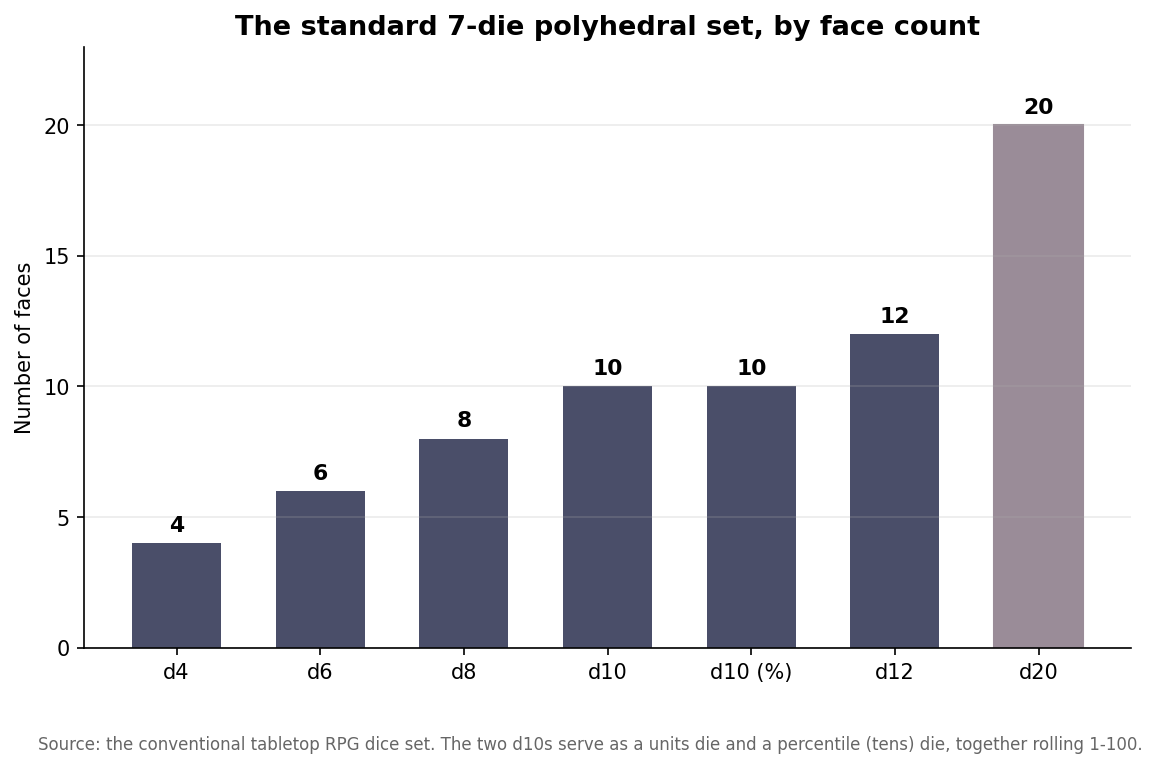
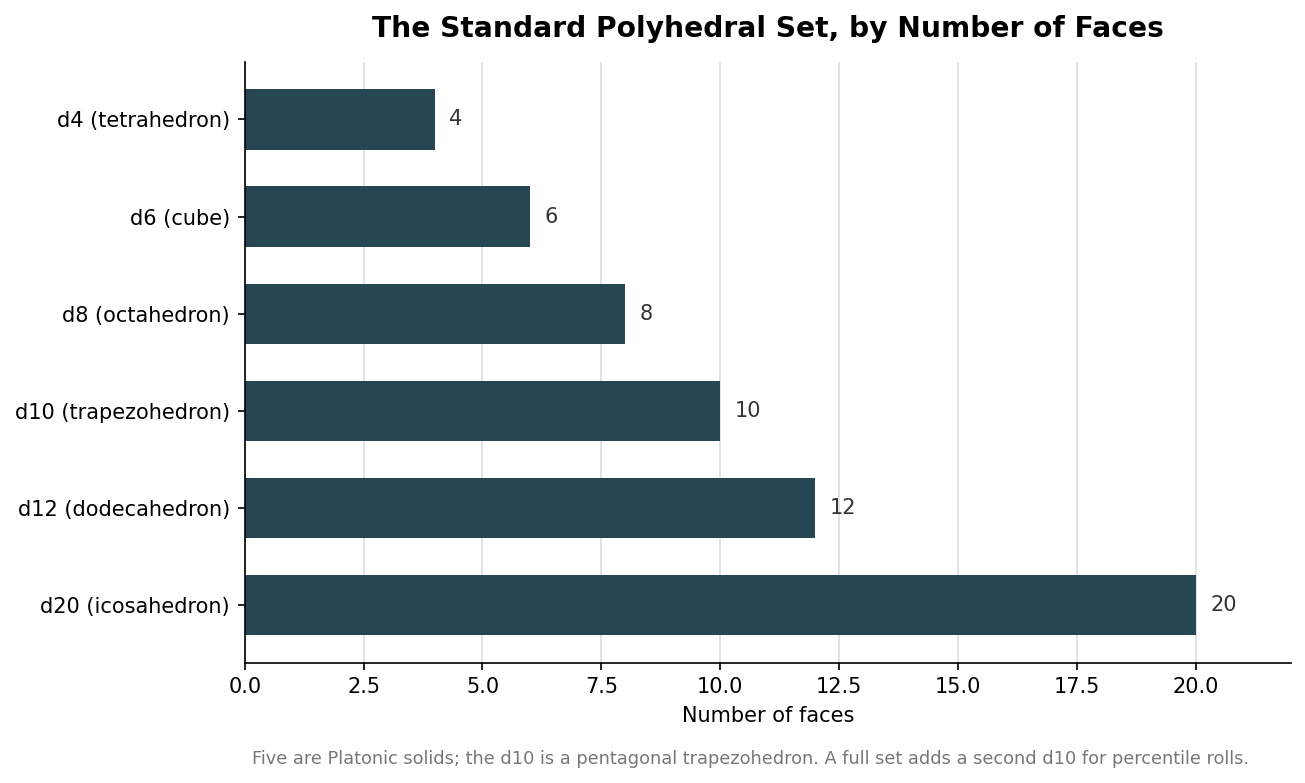
    The familiar seven-die set is d4, d6, d8, d10, d12, and d20, plus a second d10 for percentiles. The number after the d is simply the number of faces, so a d20 has twenty numbered faces and a d4 has four. The chart below lines them up by face count, which is the single most important spec because it defines the range of numbers the die can produce. A d6 gives you one through six; a d20 gives you one through twenty. When someone specifies a custom set, they are almost always talking about these seven pieces, and the extra d10 is what makes rolling a number from one to one hundred possible.

    Horizontal bar chart of the standard polyhedral dice set by number of faces, from d4 to d20
    The standard set ranked by face count, with each die’s polyhedron named.

    Why these particular shapes

    Five of the shapes are the Platonic solids, and that is not a coincidence. A Platonic solid is a shape whose faces are all identical regular polygons meeting in the same way at every corner, and there are exactly five of them: the tetrahedron with four faces, the cube with six, the octahedron with eight, the dodecahedron with twelve, and the icosahedron with twenty. That perfect symmetry is precisely what a fair die needs, because if every face is identical then no face is favored. This is why the d4, d6, d8, d12, and d20 look the way they do rather than being arbitrary lumps with numbers on them.

    The d10 is the exception worth knowing. There is no Platonic solid with ten faces, so the ten-sided die is built as a pentagonal trapezohedron, a shape made of ten kite-shaped faces. It is still designed to be fair because its faces are identical to one another, but it is a different family of geometry from the other five. Mention this when a customer asks why their d10 has that distinctive elongated, diamond-faceted look while the rest of the set is made of tidy triangles and pentagons. It is also why the two d10s in a full set can be numbered differently, one running zero through nine and the other in tens from zero to ninety, so that rolled together they read as a single number from one to one hundred.

    What the probabilities actually are

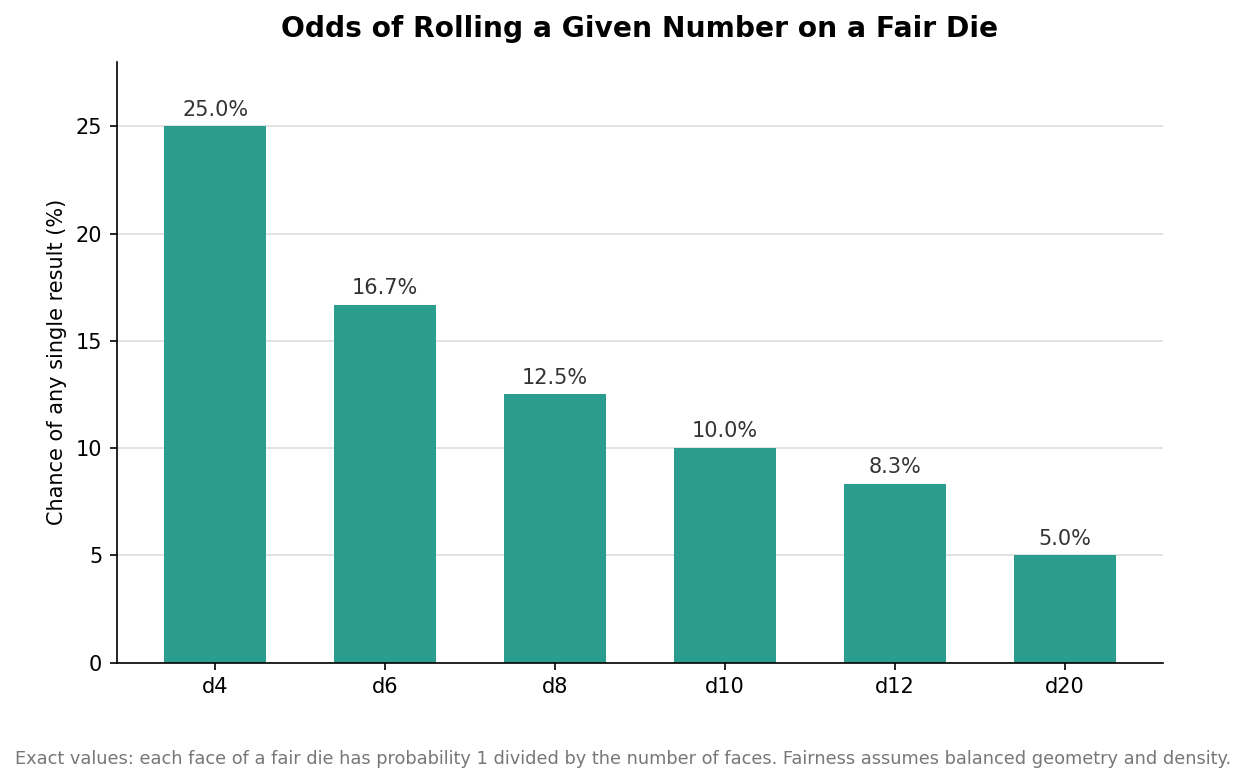
    On a fair die, every face is equally likely, and the odds are exactly one divided by the number of faces. That makes a single result on a d4 a one-in-four event, or twenty-five percent, while a specific number on a d20 comes up only five percent of the time. The second chart shows these exact values across the set. They matter for design as much as for play: a game that leans on the d20 is built around rarer, higher-variance outcomes, while one that uses the d6 produces flatter, more predictable results. If you are commissioning dice for a specific game or classroom exercise, choosing the die is really choosing the probability curve you want.

    Bar chart of the exact probability of any single result on each fair die from d4 at 25 percent to d20 at 5 percent
    Exact odds of any single result on a fair die: one divided by the number of faces.

    One caveat belongs with that math. The clean percentages assume a genuinely fair die, which depends on balanced geometry and uniform density. A die with an off-center bubble in the resin, uneven paint fill weighting one face, or rounded-inconsistent edges will drift from these ideals, which is why manufacturing quality is not separate from fairness but part of it.

    Matching the set to the job

    Not every project needs all seven shapes. A tabletop role-playing product typically wants the full set because the rules call on different dice for different actions, with the d20 doing the heavy lifting for checks. A board game or a promotional giveaway is often better served by custom d6s alone, which are cheaper per unit, stack and pack easily, and carry a logo or custom pips cleanly on their flat faces. An educational set might emphasize the d6 and d10 for teaching probability and place value, where the whole point is that students can see and feel why a ten-sided die produces flatter odds than a four-sided one. A marketing or event set often does best with a single distinctive die that carries the brand well and survives being handled and pocketed. And a precision or casino-style application is a different world again, built around larger, sharp-edged, tightly toleranced cubes, commonly around three-quarters of an inch, rather than the roughly sixteen-millimeter dice that fill a standard polyhedral set. Decide what the dice are for, and the shapes, sizes, and quantities follow from there rather than the other way around.

    Once the geometry is clear, the rest of a custom order, material, edge style, decoration, size, and packaging, sits on top of a solid foundation. Knowing that the numbers you can roll come straight from the number of faces, that symmetry is what keeps a die honest, and that the d10 is the odd one out, is enough to specify a set with confidence and to explain every piece of it to the person who ends up rolling it.

  • How to Spec a Bulk Custom Dice Order: Size, Edges, Decoration, and Packs

    How to Spec a Bulk Custom Dice Order: Size, Edges, Decoration, and Packs

    A custom die is a small object with a surprising number of decisions packed into it. Get the size wrong and a promotional die is unreadable across a trade-show table; get the edges wrong and a set meant for a casino feel rolls like a toy. When you order in bulk, those choices multiply across thousands of units, so it pays to specify them deliberately rather than accept a factory default. This is a working walkthrough of the specs that actually change the product, in the order you should decide them.

    Start with size, because size sets everything else

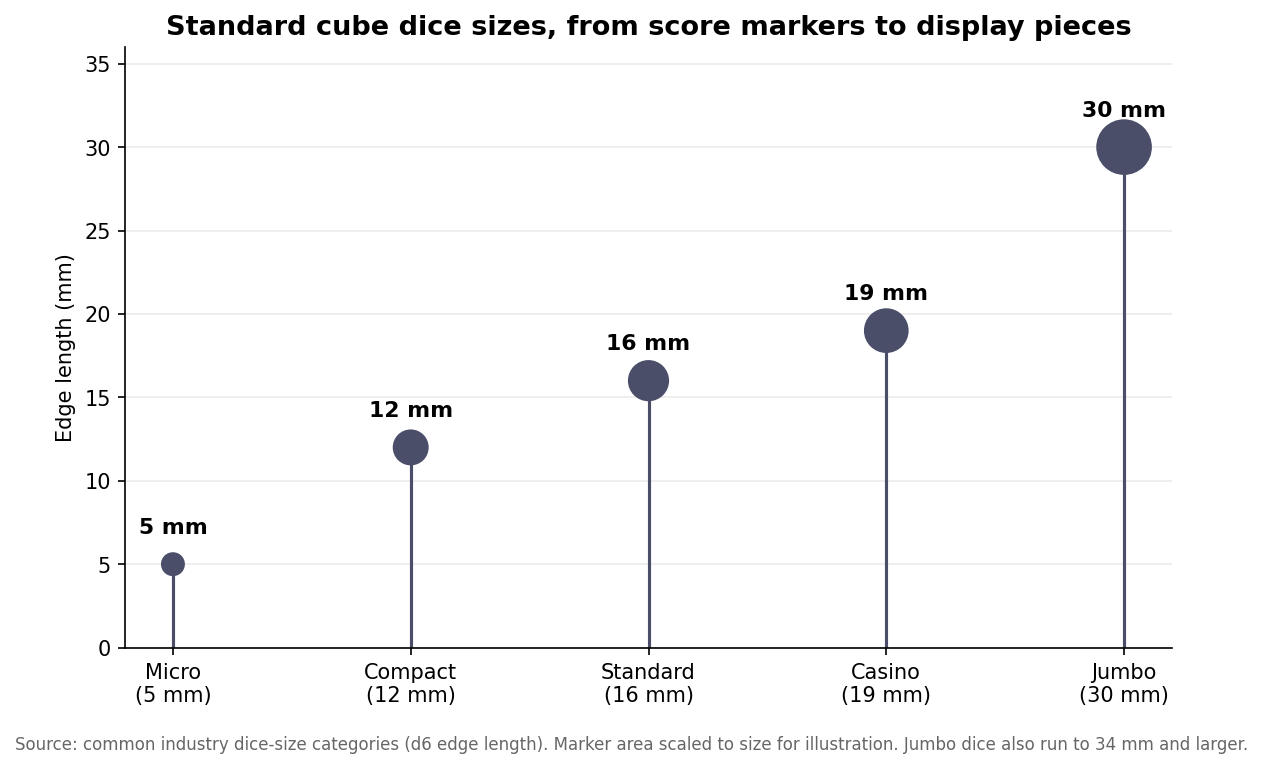
    Dice are measured by the edge length of the cube, and a handful of sizes cover almost every use. The industry benchmark is 16 millimeters, the size of a classic board-game or tabletop die, comfortable to pick up and read. Casinos and party games favor 19 millimeters, big enough to read across a table and to carry sharp, precise edges. Compact 12 millimeter dice are built for rolling many at once, the norm in miniature war games, while 5 millimeter micro dice serve as score or status markers. At the other end, jumbo dice of 30 millimeters and up are display and novelty pieces rather than playing dice.

    Lollipop chart of standard cube dice sizes from 5mm micro to 30mm jumbo by edge length
    Common cube dice sizes by edge length, from score markers to display pieces.

    Size drives everything downstream. It sets how much room you have for artwork on each face, how legible small pips or numerals will be, and how heavy and expensive the finished die is in bulk. Decide it first and every later choice gets easier.

    Edges: rounded for play, sharp for precision

    The corners and edges of a die are a real specification, not a cosmetic afterthought. Mass-market molded dice have gently rounded edges and corners, which makes them tumble freely and forgiving to handle, the right call for board games and giveaways. Precision or casino-style dice use sharp, near-square razor edges, which look crisp and are associated with fair, controlled rolls, but they are less comfortable in the hand and show wear faster. If your dice are for play and promotion, rounded is almost always right; reserve sharp edges for products where a precise, high-end feel is the point.

    How the faces are decorated

    There are three common ways to put numbers or a logo on a die, and they land at different price and durability points. Engraving, or debossing, cuts the pip or numeral into the face; left unpainted it is subtle and extremely durable because there is no ink to wear off. Engraved-and-painted fills that recess with color, the familiar look of white pips on a colored die, giving contrast that still resists rubbing because the paint sits below the surface. Printed or UV-printed faces lay artwork flat on top of the die, which allows full-color logos and fine detail but sits more exposed to handling wear. For a die that will be rolled thousands of times, recessed and filled decoration outlasts surface printing; for a short-run showpiece with a detailed logo, printing opens up options engraving cannot match.

    Quantities and how dice are packed

    How your dice are grouped is part of the order, not an afterthought at the warehouse. Classic six-sided dice ship as singles, as pairs for backgammon and craps, as sets of five for poker dice and Yahtzee-style games, and as bulk blocks for game publishers. Tabletop role-playing uses the standard seven-die polyhedral set, which spans four, six, eight, ten, twelve, and twenty faces, with two ten-sided dice that together roll one to a hundred.

    Bar chart of the standard seven-die polyhedral RPG set showing face counts of 4, 6, 8, 10, 10, 12, and 20
    The standard seven-die polyhedral set and the face count of each die.

    Per-unit pricing depends heavily on the die size, the decoration method, and whether you want custom colors, so treat any price as indicative until it is on a written quote. At Get Custom Dice the minimum order is 12 dice per design; as a rule, custom colors and multi-step decoration raise the per-die price, while a single-color engrave on a standard size keeps it lower. Decide your pack configuration early, because a set of seven mixed shapes is a very different manufacturing job than a bulk run of one cube.

    Color and contrast that survive a table and a photo

    Color is where custom dice either read instantly or turn to mush, and it works on two layers: the body of the die and the fill in the numbers. A high-contrast pairing, light pips on a dark body or the reverse, stays legible across a table and in a product photo; a tonal pairing like gray on charcoal looks elegant in the hand but disappears at a distance and photographs poorly for a listing. Translucent and swirled bodies add visual interest but can fight legibility, because a numeral has to compete with the pattern behind it, so they reward a bolder, higher-contrast fill. If the die carries a brand color, decide whether that color belongs on the body, in the pip fill, or both, and check it at the actual finished size rather than on a zoomed-in screen where everything looks readable. A face that reads cleanly at 16 millimeters is a different design than one that only works blown up.

    Putting a spec sheet together

    Bring five things to a quote and you will get an accurate one back. State the size in millimeters, the edge style as rounded or sharp, the material, the decoration method, and the pack configuration with the total quantity. Add your color, whether that is a body color, a pip or ink color, or both, and note any artwork that has to reproduce cleanly at the chosen size. With those settled, the rest of the conversation is about lead time and tooling rather than guesswork, and the dice that arrive match the ones you pictured. Specify loosely and you inherit the factory’s defaults; specify tightly and the small object does exactly what you need it to.

  • Custom Dice Materials Compared: Acrylic, Resin, Metal, and Stone

    Custom Dice Materials Compared: Acrylic, Resin, Metal, and Stone

    Two custom dice can carry the same artwork, the same numbers, and the same size, and still feel like entirely different objects in the hand. The reason is material. What a die is made of governs its weight, the sharpness of its edges, how much fine detail the mold can hold, how it survives a fall onto a hard floor, and a good part of what it costs to produce. Before locking a color or a logo, it pays to understand what each material does well and where it gives something up. This is a look at the main options a custom order will put in front of you.

    Acrylic and resin are both plastic, and they are not the same

    The two materials that cover most custom dice are acrylic and resin, and buyers often treat them as interchangeable when they are not. Acrylic is a thermoplastic that is molded and sets as it cools, which lends itself to bright, saturated colors and clean, simple shapes produced consistently at scale. Its limitation is detail: because the material is comparatively soft, molds cannot hold very fine features, so acrylic dice tend toward bold designs with slightly softer edges, and painted numbers can wear away over time if the dice are handled hard.

    Resin works by a different mechanism. It is cast from two components that harden through a chemical reaction, and that process allows far more intricate molds, including sharp edges and embossed or debossed detail that acrylic cannot reproduce. Resin is also harder and more scratch-resistant, and its transparency lets makers suspend glitter, metal foils, mica, or other inclusions inside the die. The trade-off is cost and consistency: resin dice are almost always more expensive because the process is slower and more hands-on, and small batch variation is part of their character rather than a defect. For a large promotional run in a couple of solid colors, acrylic is usually the sensible choice; for a premium, detailed, or collectible piece, resin earns its price.

    Metal is weight you can feel

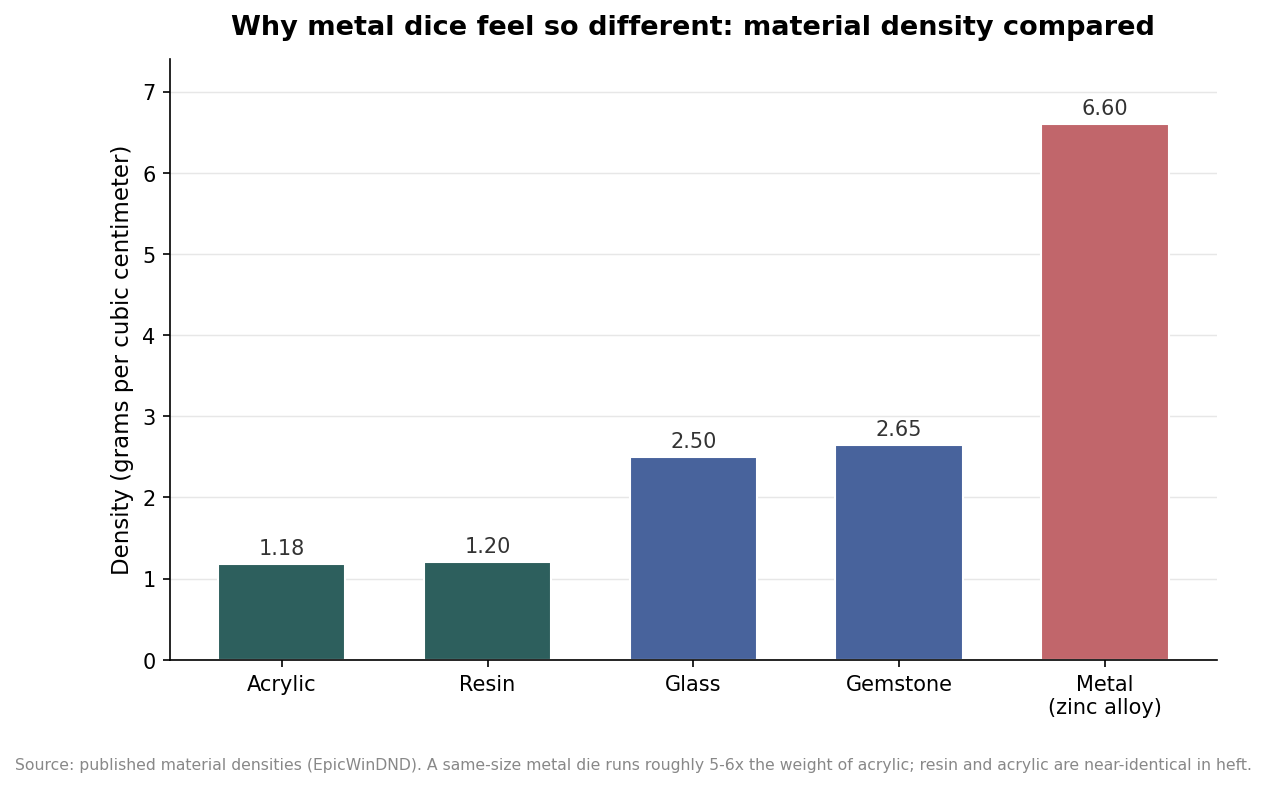
    Metal dice, usually cast from a zinc alloy and then plated, occupy the opposite end of the spectrum from plastic. The defining property is heft. A material’s density tells the story cleanly: acrylic and resin sit right around 1.2 grams per cubic centimeter, glass and gemstone roughly double that, and solid zinc alloy lands near 6.6, which works out to a same-size metal die weighing on the order of five to six times its plastic equivalent. The chart below lays those densities side by side, and the gap is the whole reason metal dice have their reputation.

    Bar chart comparing the density of dice materials in grams per cubic centimeter, with metal far heavier than acrylic and resin
    Material density explains the feel: metal dice run 5-6 times the weight of acrylic or resin of the same size.

    That weight changes behavior on the table. Metal dice settle quickly with little bounce and land with a solid thud rather than a clatter, which many players prize and which also makes them feel substantial as a gift or a keepsake. Durability is excellent; the main cosmetic change over years of use is that the plating slowly wears and a patina develops. The costs are real, though: metal dice are heavier to ship, more expensive to produce, and hard enough that a dropped set can chip a table or a glass surface, so they are typically rolled in a tray. For a custom order meant to impress, metal delivers; for volume giveaways where postage matters, its weight is a line item.

    Stone, glass, and wood fill the specialty tier

    Beyond the plastics and metal sit a set of specialty materials chosen more for character than for practicality. Gemstone dice are cut and polished from natural stone, giving each one a unique grain and a medium-heavy feel at roughly 2.2 times the weight of acrylic, but stone is brittle and can crack if dropped on a hard floor, and the premium pricing reflects the labor of cutting. Glass offers a clear, bell-like sound and a medium weight but is similarly brittle. Wood is light, warm, and quiet on the table, with a soft thump rather than a clack, though it can warp with exposure to moisture and holds less fine detail than resin. None of these is the right pick for a rugged, high-volume run, but each makes sense when the material itself is meant to be part of the appeal.

    Size changes everything about the feel

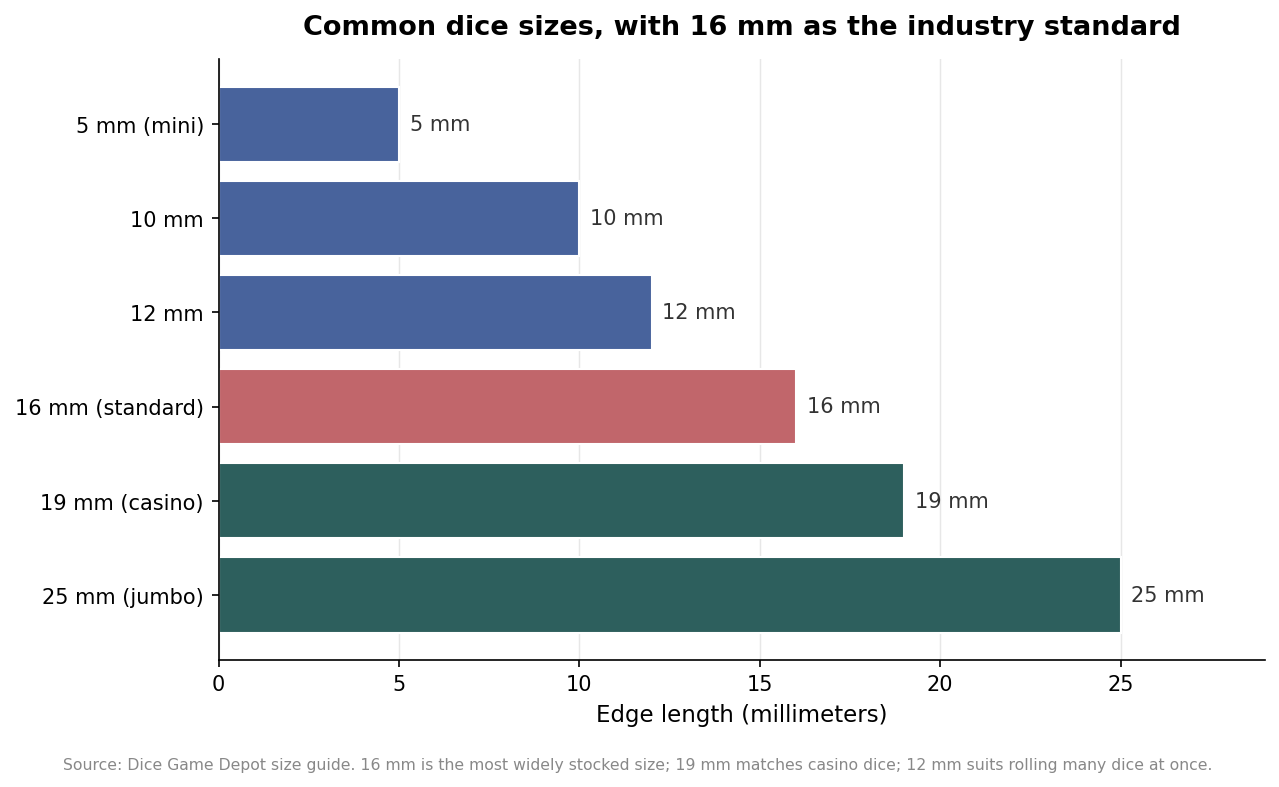
    Material is only half the equation; size interacts with it strongly. The industry standard for a six-sided die is 16 millimeters, and it is the size with the widest selection of colors, finishes, and designs, which makes it the safe default for most custom work. Smaller 12-millimeter dice are favored when players roll many at once, as in mass-battle miniatures games, while 10-millimeter and 5-millimeter dice serve compact sets and specialty uses. Going the other way, 19 millimeters matches casino gaming dimensions and reads well from across a table, and jumbo sizes of 25 millimeters and up move into display and novelty territory. The chart below shows the common sizes on one scale.

    Horizontal bar chart of common dice edge sizes in millimeters from 5mm to 25mm, highlighting 16mm as standard
    Common dice sizes on one scale, with the 16 mm industry standard highlighted.

    The reason size deserves attention on a metal or stone order in particular is that weight scales with volume, not with edge length. Doubling the edge of a die multiplies its volume, and therefore its weight, by roughly eight. A 19-millimeter metal die is not a little heavier than a 16-millimeter one; it is dramatically heavier. That compounding is why honest sellers quote weight as a range tied to a specific size rather than a single number, and why picking size and material together, rather than in sequence, avoids surprises.

    Matching the material to the job

    The right material follows from how the dice will be used. A large branded run in a few solid colors points to acrylic for its low cost and consistent output. A detailed, transparent, or inclusion-filled design points to resin, accepting a higher price and some batch variation. A premium gift or a set meant to feel serious points to metal, with its shipping weight and tray-friendly hardness factored in. Stone, glass, and wood are for when the material is the message. Set the size in the same breath, defaulting to 16 millimeters unless the game or the display calls for something else, and remember that on the heavier materials a step up in size is a large step up in weight and cost. Chosen this way, the finished dice feel in the hand exactly the way the design promised on the screen.

  • What Actually Makes a Die Fair

    Almost every die in the world is slightly biased, and for almost every purpose that is completely fine. Knowing where the bias comes from is what lets you decide whether it matters for what you are making.

    Source one: hollow pips

    A standard die has its pips drilled out. The six face loses six pips of material; the one face loses one. The die is therefore very slightly lighter on the six side, which means the six side comes up slightly more often.

    The effect is small but real and it is entirely systematic. Precision dice fill every pip flush with material of matched density, which removes the source rather than compensating for it.

    Source two: rounded corners

    Molded dice are tumbled to remove flash, which rounds the corners and edges. Rounded dice roll longer and settle more randomly, which sounds good but actually makes the die more sensitive to tiny asymmetries in shape.

    Casino dice have razor edges: square, sharp and machined. They tumble less predictably in the air and settle decisively, which combined with flush pips is what makes them fair.

    Source three: manufacturing tolerance

    Injection molding holds a tolerance of a few hundredths of an inch, which is invisible and still enough to bias a die slightly. Machined precision dice hold a few thousandths — an order of magnitude tighter.

    This is the part that costs money, and it is why precision dice are priced where they are.

    When it genuinely matters

    Casinos, card rooms and sanctioned tournaments, where the fairness of the die is part of the product and someone may reasonably ask. Also statistical or educational use, where the distribution is the point.

    For a board game, a giveaway or a retail set, the bias is far smaller than the variance any player will ever notice, and paying for precision is paying for a claim rather than an experience.

    What you can honestly say

    If you have precision dice, say the tolerance and say the pips are flush filled. Those are specific, checkable claims.

    If you have standard dice, do not call them casino grade, balanced or fair. Those words mean something to the people who care, and using them loosely is how a supplier loses that audience permanently.

    Testing a die yourself

    The saltwater float test — suspending a die in heavily salted water and spinning it to see whether the same face keeps surfacing — catches gross bias and nothing subtle. It is a useful sanity check and not a measurement.

    Real testing is thousands of rolls or a density measurement. If you need that, you need precision dice, and we will supply them with the tolerance stated.

  • Designing a Custom Face Set That Reads at a Glance

    A custom face set is the best value in custom dice and the easiest thing to get wrong. The die is read at speed, at an angle, from a couple of feet away, usually by someone mid-conversation.

    Everything below follows from that.

    Silhouette does the work, not detail

    At 16mm a face is smaller than a fingernail. What survives is the outline — whether the shape is round, angular, tall or wide. Interior detail turns to texture.

    Design your icons as solid silhouettes first and only add detail if it survives being printed at actual size. We render every face set at true size for exactly this reason.

    Six faces need six distinct shapes

    The most common failure is an icon set where three faces are all roughly circular. Players then have to read rather than recognise, which slows the game and makes the dice feel unpleasant to use.

    Lay all six out in a row in silhouette and squint. If any two read the same, redraw one.

    Keep one face conventional if you can

    Replacing every face makes a die unreadable to anyone who has not learned the set. Retaining one recognisable anchor — a blank, a single pip, a number — gives new players something to orient from.

    This matters most for dice sold at retail, where somebody picks the set up with no rulebook in front of them.

    Weight the set deliberately

    A custom face set is also a probability distribution. Two identical faces mean that outcome is twice as likely, which is a design tool and a trap in equal measure.

    Write out the intended distribution before you design the icons, not after. We have seen more than one game rebalanced late because the dice were drawn before the maths was settled.

    Color is a second channel, and a weak one

    Color fill can reinforce a face set but should never be the only difference between two faces. Roughly one man in twelve has some form of color vision deficiency, and dice are often used in poor light.

    Use color to group or emphasise. Use shape to distinguish.

    The d20 twenty face

    On polyhedral sets, the twenty face is the branding slot everyone wants. It is also the face players most need to identify instantly, often across a table and upside down.

    A simple mark works. A detailed logo does not, and it produces genuine friction at the table. We will show it at actual size and tell you honestly which one yours is.

    What to send us

    Vector icons if you have them, or descriptions if you do not — our design team draws face sets routinely. Include the intended distribution, and tell us what the dice ship alongside so the visual language matches.

  • The Complete Buyer’s Guide to Custom Dice

    Dice look like a commodity and behave like a component. The difference between a good custom die and a poor one is almost entirely in construction, and none of it is visible in a product photograph.

    This guide covers the four choices you have to make and the two details worth insisting on regardless of which way you go.

    Material comes first

    Injection-molded plastic for volume and full-color print. Cast resin for seven-piece polyhedral sets, where swirls and layered pours are the selling point. Solid hardwood for premium editions that get left out on a table. Die-cast metal where weight is the pitch. Foam for anything oversized. Machined acetate where fairness has to be provable.

    Each is right somewhere and wrong everywhere else. The most common mistake is buying metal for a component that ships inside a box, where the cost lands on the game rather than on a customer who wanted it.

    Size changes the object more than you expect

    16mm is the board game standard and the right size when dice ship inside a box with other components. 19mm is noticeably better in the hand, reads across a table, and photographs far better — which matters enormously on a crowdfunding page.

    Oversized foam at 100mm and up is a different product entirely: a prop rather than a component, bought because it gets picked up.

    Custom face sets cost the same as one face

    Setup is per die, not per face. Once you are paying to customize a die at all, replacing all six faces costs nothing extra, and it is where branded dice stop being decoration and start being useful.

    Prize names, drink categories, exercises, discussion prompts, product ranges, your own icon set. If the faces are doing a job, people keep the die.

    Detail one: recess-filled printing

    A printed face can have the color sitting on the surface or filled down into a recess. Surface print polishes off — a year in a dice bag and the pips are ghosts. Recess fill sits below the surface where nothing rubs it.

    Ask which one you are getting. It is the single biggest determinant of how a printed die looks after real use and it costs almost nothing.

    Detail two: what makes a die actually fair

    Standard dice are molded and tumbled, which rounds corners, and their pips are drilled hollows. Both bias the roll. A six face missing six pips of material is measurably lighter than a one face missing one.

    Precision dice fix both: razor edges machined square, and every pip filled flush with density-matched material. If fairness is part of what you are selling, nothing short of that is honest.

    Color, and why we send physical samples

    Solid printed colors match a reference reliably. Resin swirls, glitter suspensions and layered pours do not, because no two pours are identical — that variation is the product.

    Any supplier who approves a resin colorway from a render is setting you up for a surprise. We send a physical sample and would rather lose two weeks than ship ten thousand of the wrong thing.

    What to send us

    Your artwork, the material you are leaning toward, the size, roughly how many, and your palette references. If it is a game, tell us what the dice ship alongside — matching a component set changes what we recommend.